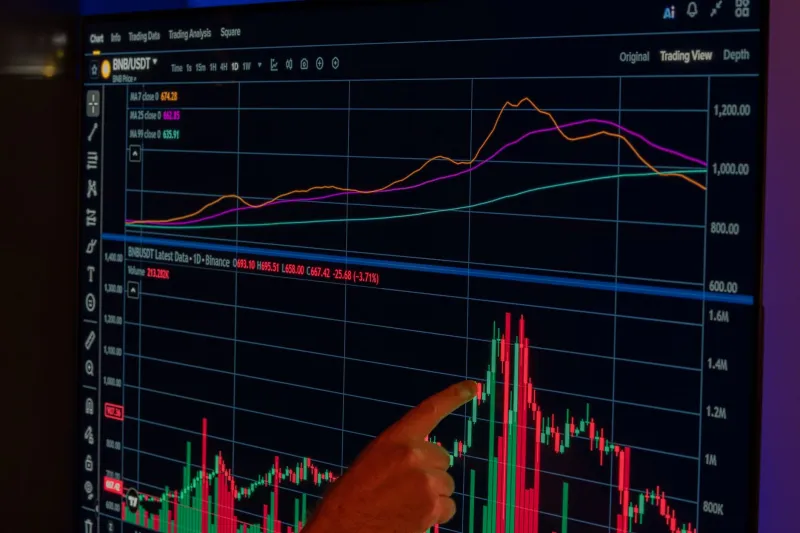
Decoy Movements: How Institutional Crypto Actors Engineer Liquidity Traps to Punish Followers

The appeal is intuitive. A wallet holding nine figures in Bitcoin suddenly shifts a substantial portion to an exchange. On-chain data is public. The movement is visible. The reasoning appears obvious: something is about to happen, and following the signal should position you ahead of it.
This logic has cost serious wagerers substantial capital. The assumption that large holder visibility equals directional intelligence is one of the more dangerous misconceptions operating in professional crypto circles today. At 789WinPro, we have observed this pattern consistently enough to treat it as a structural hazard rather than an occasional anomaly.
Understanding why requires moving beyond what on-chain data shows and interrogating what it is designed to make you believe.
The Transparency Paradox in Public Blockchain Data
Public blockchains were architected around transparency, and that transparency is genuinely valuable for a range of analytical purposes. But transparency is not neutrality. When every market participant can observe the same movements simultaneously, the most sophisticated actors — those with the deepest reserves of capital and the most refined execution infrastructure — are fully aware that their on-chain behavior is being monitored.
This awareness fundamentally changes how institutional actors behave. Rather than treating on-chain visibility as an unavoidable cost, elite market participants treat it as a tool. A transfer of funds to an exchange does not necessarily precede a sale. It may precede a sale. It may also be a rehearsed gesture designed to trigger a specific response from the cohort of followers watching the chain.
The distinction between these two scenarios is not visible in the transaction itself. It lives in context, timing, and a rigorous understanding of incentive structures.
How Liquidity Traps Are Constructed
A liquidity trap in crypto markets typically operates across several coordinated phases, though the execution varies by actor and objective.
In the first phase, a visible on-chain movement is executed — often large enough to register on monitoring platforms and aggregators widely used by professional trackers. The movement is real. Funds genuinely move. This is not fabrication; it is framing.
In the second phase, the monitoring community reacts. Retail participants, semi-professional wagerers, and even some institutional followers interpret the signal according to their existing frameworks. If the movement appears to indicate accumulation, buyers enter. If it suggests distribution, shorts pile on.
In the third phase, the originating actor — or a coordinated network of related actors — executes in the opposite direction of the crowd's position. The liquidity generated by the followers' collective entry is precisely what the institutional actor needed to execute a large opposing trade without catastrophic slippage.
The followers, now positioned incorrectly and often leveraged, face cascading liquidations as the price moves against them. The institutional actor exits with favorable fills. The transaction record, reviewed after the fact, is entirely legitimate.
Psychological Mechanisms That Amplify the Effect
The trap functions not merely because of technical execution but because it exploits specific cognitive patterns common among serious wagerers.
Confirmation bias plays a significant role. Once a professional identifies what appears to be a whale signal, subsequent data points are unconsciously filtered to support the initial interpretation. A price movement in the anticipated direction is treated as confirmation. A movement against the position is rationalized as temporary noise.
Authority bias compounds the problem. The implicit assumption is that entities controlling large amounts of capital must possess superior information. Following them therefore seems rational. This assumption ignores the possibility that the superior information they possess is specifically information about your behavior.
Urgency pressure closes the loop. On-chain movements are time-stamped and visible to competitors. The fear of missing a developing position pushes wagerers to act quickly, compressing the analytical window during which the movement's authenticity could be properly evaluated.
Distinguishing Genuine Repositioning from Manufactured Signals
No framework eliminates this risk entirely, but a disciplined evaluation process substantially reduces exposure to engineered traps.
Examine the counterparty environment. Genuine institutional repositioning typically occurs in conditions of sufficient liquidity to absorb the intended trade. When visible whale movements occur in thin market conditions — particularly during low-volume overnight sessions or immediately preceding major economic announcements — the probability of a manufactured signal increases meaningfully.
Track behavioral consistency over time. Institutional actors who are genuinely repositioning tend to exhibit patterns consistent with their historical behavior. Sudden deviations from established movement cadence, particularly in the direction of maximum visibility, warrant heightened skepticism.
Analyze the derivative markets simultaneously. Options positioning, perpetual funding rates, and open interest levels provide a parallel data stream that is significantly harder to manipulate than spot on-chain movements. Genuine directional conviction from large actors tends to leave consistent footprints across both spot and derivative markets. Divergence between these data streams is a meaningful warning indicator.
Evaluate the liquidation map. Sophisticated wagerers maintain awareness of where leveraged positions are clustered across the market. When a whale movement appears designed to push price toward a dense cluster of stop-loss orders or liquidation thresholds, the likelihood that the movement is engineered rather than organic increases substantially.
Apply a delay discipline. Perhaps the most effective tactical adjustment is the deliberate introduction of a waiting period before acting on visible whale signals. A movement that appears urgent at the moment of observation often resolves its ambiguity within a short window. The cost of this delay is occasionally a missed opportunity. The benefit is systematic protection against entering positions during the precise window when institutional actors are harvesting the liquidity of followers.
When Whale Activity Represents Genuine Opportunity
This analysis is not an argument against using on-chain intelligence. It is an argument for using it correctly.
Genuine institutional repositioning does occur, and it does create exploitable opportunities for disciplined wagerers who identify it accurately. The distinguishing characteristics tend to include gradual accumulation or distribution over extended time horizons rather than single large movements, consistency across multiple wallet clusters rather than isolated high-visibility transfers, alignment with macroeconomic context and asset-specific catalysts, and corroboration from derivative market data.
When multiple independent signals converge on the same directional thesis, the probability that any single component is manufactured as bait decreases. The professional discipline is not to ignore whale activity but to require corroboration before acting on it.
Structural Implications for Serious Wagerers
The broader lesson embedded in this dynamic concerns the nature of edge in crypto wagering markets. Edge is not a static property of a data source. It is a function of how widely that data source is understood and how it is being actively gamed by sophisticated participants.
On-chain data became widely accessible. Monitoring platforms proliferated. The community of whale-watchers grew. And as that community grew, the value of naive whale-following declined while the value of understanding how whale-following behavior is exploited increased.
At 789WinPro, our editorial position is that serious wagerers must continuously evaluate not just what the data shows, but who benefits from their interpretation of that data. In a market where the most sophisticated actors are fully aware of how their behavior will be read, taking signals at face value is not analysis. It is participation in someone else's strategy.
The professional approach treats every high-visibility on-chain movement as a hypothesis requiring independent verification — never as a directive to act.